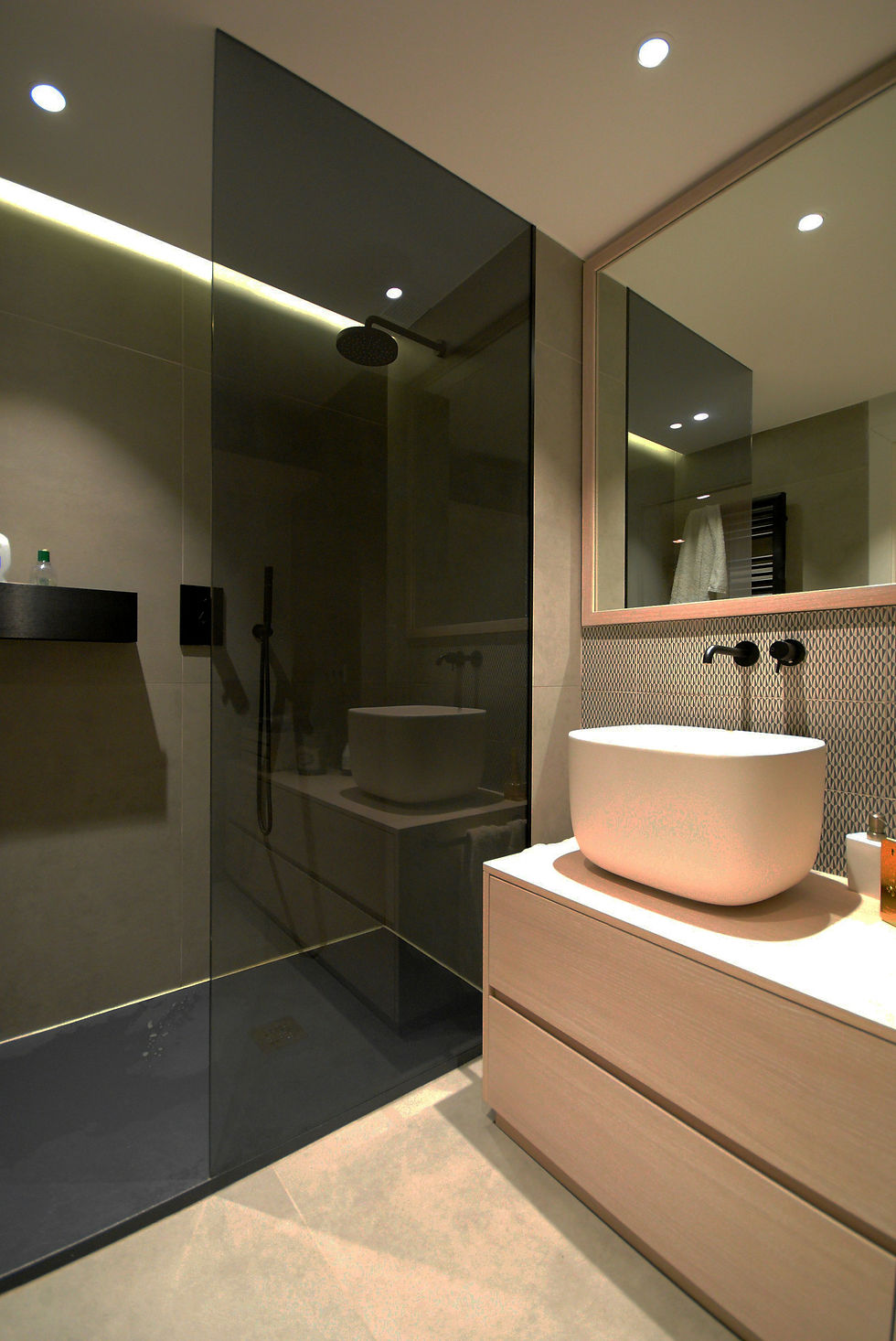
Case Study: Micro-Cement Basement Bathroom in Mount Royal
- Mike Bouchard

- Nov 21
- 4 min read

Featuring Wedi® Waterproofing System, Advanced Tools & Expert Craftsmanship
Client & Situation
Fredrick and his wife, Vivian—originally from Europe and now living in Calgary’s Mount Royal community—wanted their neglected basement bathroom to feel like the modern, spa-like ensuites they were used to overseas. They loved:
Seamless surfaces
Minimal grout lines
Light, calming finishes
High design with low maintenance
They chose micro-cement for its European aesthetic—but before we could apply a premium finish, the space presented serious structural and moisture-related challenges that required specialized tools and experienced hands.
Pre-Project Hurdles—And the Tools, Skills & Planning Required to Solve Them
A basement bathroom renovation is never just about applying a finish. Success depends entirely on solving the hidden issues first—with precision, planning, and the right materials.
Below is a deeper, more technical breakdown of each hurdle and how Elevation Renovations resolved it.
1. Previous DIY Renovation & Hidden Substrate Problems
What We Found
Uneven walls
Misaligned corners
Different wall materials patched together
No proper waterproofing—especially in the shower
Substrate movement risks that could crack micro-cement
Why This Is Serious
Micro-cement is thin—every flaw telegraphs through it. An unstable substrate = future cracks or delamination.
Tools & Skills Needed
Rotary hammer & oscillating multi-tool: for clean demolition and to remove old tile and backer without damaging structure.
Laser level (cross-line): to realign walls, corners, and ensure surfaces were perfectly plumb.
Straightedges & feathering trowels: to re-plane uneven areas before panels were installed.
Skim-coating expertise: to create a uniform surface ready for Wedi and micro-cement.
Our Solution
Selective demolition using oscillating tools to expose hidden layers safely.
Rebuilding the substrate using proper cementitious materials.
Re-establishing straight walls using laser-guided alignment and precision shimming.
Preparing surfaces for Wedi waterproof panel installation.
This step required craftsmanship and construction knowledge, because micro-cement only looks as good as the substrate beneath it.
2. Moisture Concerns & Cold Basement Walls
What We Found
Past staining on lower wall sections
Cool foundation walls causing seasonal condensation
A faint but noticeable musty smell
Why This Matters
Moisture trapped behind walls ruins micro-cement, causes mould, and undermines the entire structure.
Tools & Skills Needed
Moisture meter: to test the wall assembly and slab moisture levels.
Thermal camera: to identify cold spots and condensation-prone zones.
Foundation crack-seal technique: knowledge of proper patching materials and bonding products.
Our Solution
Moisture testing to confirm no active leaks.
Local remediation of minor issues—sealants, corrections to exterior grade (with client coordination).
Improved insulation strategy behind walls to limit temperature swings.
Use of Wedi system, which is:
Waterproof
Lightweight
Dimensionally stable
Ideal for basements where moisture control is critical
This required an installer skilled in building science, waterproofing, and precision carpentry.
3. Low Ceilings & No Natural Light
What We Found
Low clearance
No windows
Outdated lighting that emphasized every flaw
Why It’s a Challenge
A tight basement washroom can feel small and shadowy, regardless of finish.
Tools & Skills Needed
The lighting designer’s approach to layer light correctly
Laser level & stud-finder to install recessed fixtures safely
Electrical experience (licensed electrician) to relocate and add lighting circuits
Our Solution
Installed slim recessed LED fixtures for even brightness.
Positioned lights to graze walls, highlighting micro-cement texture.
Used a light-grey micro-cement that reflects light and brightens the space.
The skill here is understanding light behavior on different textures and controlling the environment to make a small space feel open.
4. Plumbing Layout, Drain Relocation & Curbless Shower
What We Found
Shower drain in a poor location for a curbless design
Inconsistent floor slope over old concrete
A curb that Fredrick and Vivian wanted removed
Why This Is High-Risk
Curbless showers require perfect slopes and waterproofing—especially in basements, where leaks remain hidden.
Tools & Skills Needed
Jackhammer or concrete saw: for selective slab cuts to move the drain.
Slope gauges & digital angle finders: to create precise floor gradients.
Wedi Fundo shower systems expertise: to install pre-sloped waterproof components correctly.
Flood-testing knowledge to confirm perfect performance before finishing.
Our Solution
Drain relocation with a licensed plumber.
Re-sloping the shower pan over the slab to ensure water moved efficiently.
Installing the Wedi® Fundo system, which gives:
Built-in slope
Complete waterproofing
A rigid base ideal for micro-cement
Flood test to validate waterproofing before moving on.
This required tile-system expertise, carpentry precision, and plumbing coordination.
5. Code Compliance & Long-Term Finish Stability
What We Found
Previous work did not align with best practices
Substrate transitions were questionable
No proof of previous waterproofing
Tools & Skills Needed
Knowledge of Alberta building code
Understanding of compatible materials (primers, membranes, micro-cement systems)
Professional installation of Wedi & micro-cement
Our Solution
Treating the project as a new build—not relying on old work.
Using a completely compatible system:
Wedi panels
Wedi sealants
Micro-cement approved primers and bonding agents
Precision timing for:
Cure stages
Membrane drying
Micro-cement layers and sanding
This requires a skilled tradesperson, not just a cosmetic installer.
Design & Micro-Cement Installation
Once the hidden problems were addressed, we moved into design and finishing:
Warm, modern European-style micro-cement chosen by Fredrick and Vivian
Multiple thin coats, troweled and sanded by hand
Seamless integration of walls, niche, and shower floor
High-performance sealer applied for long-term durability
This work demands:
Trowel skill
Knowledge of curing dynamics
A steady hand for edge work
Experience blending micro-cement for consistent color and motion
Micro-cement finishing is a craft, not just a product.
Final Results
The finished basement bathroom is:
Bright, warm, and modern
Seamless and easy to clean
Completely waterproof with Wedi beneath
Free of grout lines and clutter
A true reflection of the European minimalism Fredrick and Vivian love
Guests often can’t believe it’s a basement bathroom.
Key Takeaways
The beauty of micro-cement depends on the invisible craftsmanship behind it.
Wedi® systems provide reliable waterproofing for basements where water management is crucial.
Solving substrate, moisture, and plumbing challenges properly requires:
Professional tools
Building-science knowledge
Skilled installation
Micro-cement looks simple—but only when the work underneath is extraordinary.
Call to Action
If you’re considering micro-cement or a basement bathroom renovation in Mount Royal or anywhere in Calgary, Elevation Renovations specializes in:
Wedi waterproof systems
Micro-cement finishing
Precision building and substrate correction
Basement moisture and drainage solutions
Reach out to book a consultation and bring European-inspired craftsmanship to your home.


Comments